
Why Motorcycle Riders Need Heated Gloves
There’s a unique kind of misery in riding a motorcycle with frozen hands. As wind chill intensifies at speed, exposed fingers lose feeling within minutes. Numb hands don’t just hurt — they’re dangerous. Reduced grip strength means longer braking distances, sluggish clutch control, and slower throttle response. In extreme cases, riders lose the ability to operate handlebar controls entirely.
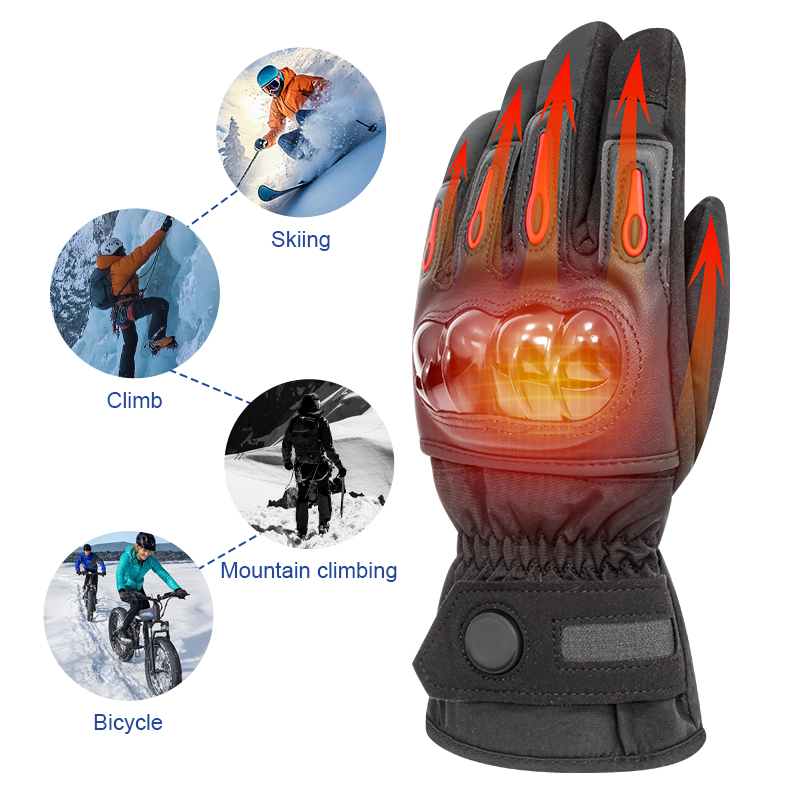
Heated gloves for motorcycle riding are the most effective solution for extending your riding season safely into late autumn, winter, and early spring. Unlike heated grips (which only warm your palms), heated gloves deliver warmth to every finger, the back of your hand, and sometimes your fingertips — the areas that suffer most in cold wind.
This guide covers everything motorcycle riders need to know about choosing heated gloves: heating performance, battery options, grip and control compatibility, safety standards, and the features that actually matter at 70 mph in 30°F air.
The Cold-Weather Riding Problem
To understand why heated gloves outperform every other cold-weather solution for motorcyclists, it helps to understand what happens to your hands on a cold ride.
Wind Chill at Speed
At 60 mph in 40°F (4°C) air, the effective temperature on your hands is roughly 25°F (-4°C). At 70 mph in 30°F (-1°C) air, it feels like 9°F (-13°C). Wind chill strips heat from exposed skin exponentially faster than still air, and even insulated gloves can’t keep up once the temperature differential becomes extreme.
Why Heated Grips Aren’t Enough
Heated handlebar grips are popular, but they have a fundamental limitation: they only heat your palms. Your fingers — which operate the clutch, brake, and throttle — remain exposed to wind chill. The result is a strange sensation where your palms are warm but your fingers are freezing, which can actually make riding more uncomfortable, not less.
Heated gloves solve this by distributing heat across your entire hand, including the fingertips that matter most for fine motor control.
Key Features for Motorcycle Heated Gloves
Motorcycle riding places unique demands on gloves that skiing or hunting don’t. Here’s what to prioritize:
1. Heating Performance and Coverage
For motorcycle use, you need gloves that heat quickly and maintain consistent output at speed. Look for:
- Carbon fiber heating elements — they heat evenly and tolerate the constant flexing that occurs while riding
- Full-hand heating coverage including fingers and fingertips, not just the back of the hand
- Fast heat-up time — under 30 seconds to reach operating temperature, so you’re warm before you hit the highway
- Multiple heat settings (at least 3) so you can adjust as temperatures change during a long ride
Premium heated gloves from manufacturers like NRheat use carbon fiber elements that reach 45°C (113°F) in approximately 8 seconds, with heat settings that let you fine-tune output for different riding conditions.
2. Battery Type: Built-In vs. External
Motorcycle riders have two battery options for heated gloves:
Built-in rechargeable batteries (7.4V lithium-ion)
- Self-contained system, no wiring to the bike
- Typically 2,200–5,000mAh capacity
- Runtime: 2–8 hours depending on heat setting
- Best for: commuting, short rides, and riders who switch between multiple gloves
Motorcycle-powered (12V direct connection)
- Connects to your bike’s battery via wiring harness
- Unlimited runtime while the engine is running
- Requires installation of a wiring lead to the battery
- Best for: long-distance touring and riders who only use one pair of gloves
For most riders, 7.4V rechargeable heated gloves offer the best balance of convenience and performance. They’re easy to swap between bikes, require no installation, and modern battery capacities easily cover a full day of riding on medium settings.
3. Palm Grip and Handlebar Compatibility
This is where motorcycle heated gloves differ most from other types. Your gloves must provide:
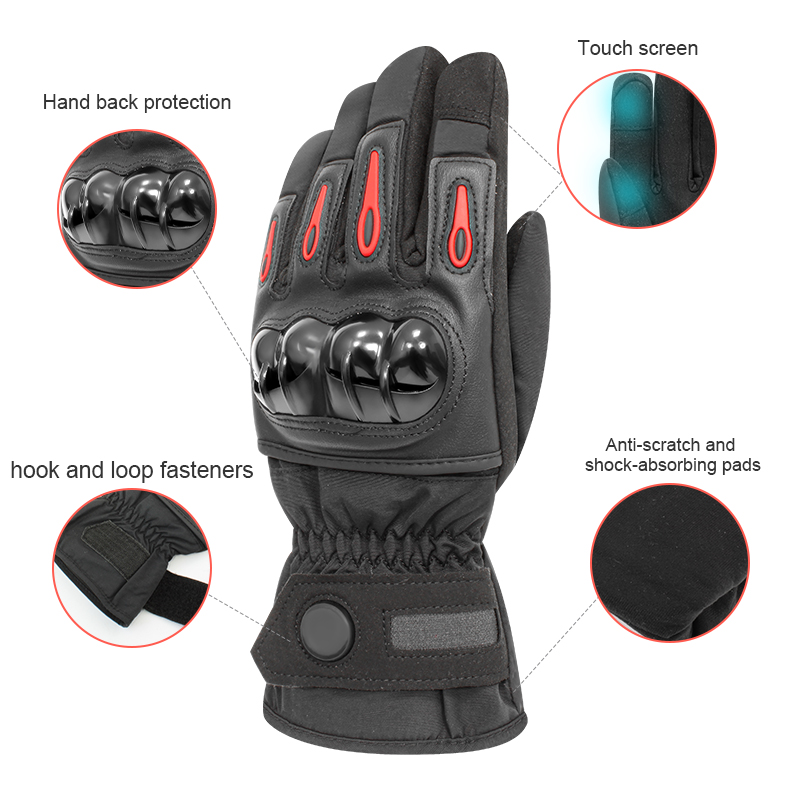
- Reinforced palm material — goatskin leather or synthetic equivalents that maintain grip on rubber grips hour after hour
- Pre-curved finger construction — reduces fatigue by matching the natural curve of your hand on the bars
- Tactile sensitivity — you need to feel the clutch and brake levers through the glove
- Knuckle protection — hard or foam armor across the knuckles for impact protection (a standard motorcycle glove feature)
4. Windproofing and Water Resistance
At highway speeds, even light rain feels like needles. Your heated gloves need:
- A windproof outer shell to prevent cold air from penetrating the insulation
- Water-resistant or waterproof construction (look for IPX4 or higher ratings)
- Extended cuffs that fit under or over your jacket sleeves to seal out wind and rain
- Adjustable wrist closures to prevent cold air from entering at the cuff
5. Visibility and Reflectivity
Winter riding often means low-light conditions. Heated gloves with reflective accents on the fingers and back of hand improve your visibility to other drivers during early morning and evening commutes.
Understanding Battery Life on the Road
Battery life is the single biggest concern for riders considering heated gloves. Here’s what to expect in real-world riding conditions:
Realistic Runtime Expectations
| Heat Setting | Ambient Temp | Expected Runtime (3,000mAh) |
| High (130–150°F) | Below 30°F (-1°C) | 2–3 hours |
| Medium (110–125°F) | 30–45°F (-1 to 7°C) | 4–5 hours |
| Low (95–105°F) | Above 45°F (7°C) | 6–8 hours |
Tips to Maximize Battery Life While Riding
- Start on high for the first 10 minutes, then drop to medium once your hands are warm
- Pre-warm your gloves while putting on your helmet and gear — plug in the batteries indoors
- Turn down the heat at lower speeds — wind chill is less severe in city traffic
- Carry a spare battery pack in your jacket for long rides
- Charge batteries fully the night before — partial charges reduce runtime
Battery Safety on a Motorcycle
Lithium-ion batteries in heated gloves are designed for rough conditions. Quality manufacturers like NRheat build their battery packs with:
- IP67 water resistance — protected against rain and splashing
- Shock-absorbing housings — tolerate vibration from the motorcycle
- Short-circuit protection — automatic shutoff if wiring is damaged
- Overheat protection — prevents thermal runaway
Always look for CE, FCC, and RoHS certifications to ensure battery safety standards are met.
Heated Gloves vs. Heated Grips: Which Is Better?
Many riders debate between heated gloves and heated grips. Here’s an honest comparison:
| Feature | Heated Gloves | Heated Grips |
| Finger heating | Yes, all fingers | No, palms only |
| Portability | Use on any bike | Bike-specific installation |
| Runtime | Limited by battery | Unlimited while engine runs |
| Cost | 80–250 per pair | 50–150 per bike |
| Maintenance | Charge batteries | Wiring maintenance |
| Dexterity | Slightly thicker | Standard glove thickness |
Recommendation: If you ride one bike primarily in cold weather, heated grips offer unlimited warmth. If you ride multiple bikes, commute variable distances, or want finger warmth (not just palm warmth), heated gloves are the superior choice. Many riders use both — heated grips as a baseline and heated gloves for the coldest days.
Choosing the Right Fit for Riding
Fit is even more critical for motorcycle heated gloves than for other uses. Too tight, and the heating elements press against your skin, causing discomfort. Too loose, and you lose the tactile feedback needed for precise throttle and clutch control.
Sizing tips:
- Measure your dominant hand around the knuckles
- Try gloves on while holding your hands in a riding position (curved fingers)
- Ensure you can reach the brake and clutch levers without the glove binding
- Check that the throttle twists smoothly without glove interference
- Verify touchscreen compatibility if you use a GPS or phone mount
Safety Certifications for Motorcycle Heated Gloves
When combining electrical heating with motorcycle riding, safety certifications are non-negotiable. Look for gloves that carry:
- CE certification — European electrical safety standards
- FCC certification — US electromagnetic compliance
- RoHS compliance — No hazardous materials in construction
- CE EN13594 rating — Motorcycle glove safety standard (impact and abrasion protection)
Manufacturers like NRheat produce heated gloves with CE, FCC, RoHS, and ISO9001 certifications, plus dedicated motorcycle-specific models with knuckle protection and reinforced palms. Their 16+ years of heated apparel manufacturing experience means the heating systems are engineered for the vibration and weather exposure inherent to motorcycle use.
Caring for Motorcycle Heated Gloves
Motorcycle gloves take more abuse than any other type. To maximize lifespan:
- Air dry thoroughly after every wet ride — never store damp
- Remove batteries immediately after riding to prevent slow drain
- Clean with a damp cloth — avoid soaking or submerging
- Condition leather palms monthly with a leather conditioner to prevent cracking
- Inspect wiring seasonally for any signs of wear at connection points
- Store at room temperature during off-season with batteries at 50% charge
Frequently Asked Questions
Can heated gloves interfere with motorcycle electronics?
No. Quality heated gloves are FCC-certified for electromagnetic compliance and will not interfere with motorcycle electronics, GPS units, or communication systems.
Are heated gloves safe in the rain?
Motorcycle heated gloves with IPX4 or higher water resistance are designed for rain riding. The battery compartments are sealed, and heating elements are waterproof. However, never submerge gloves fully in water.
Can I wash heated motorcycle gloves?
Hand wash only with mild detergent, and always remove batteries first. Never machine wash or dry clean heated gloves unless explicitly permitted by the manufacturer.
Do heated gloves reduce my grip on the handlebars?
Quality heated gloves maintain full grip through reinforced palms and pre-curved construction. The slight added thickness is comparable to standard winter riding gloves.
Conclusion
Heated gloves for motorcycle riding are more than a comfort upgrade — they’re a safety investment. Numb, frozen hands compromise your ability to operate controls, extend braking distances, and turn an enjoyable ride into a painful ordeal. By delivering consistent, adjustable warmth directly to your fingers, heated gloves let you extend your riding season by months and arrive at your destination with hands that still work.
For riders and retailers seeking premium heated riding gloves, NRheat offers OEM and ODM manufacturing with 16+ years of expertise in heated apparel. Their heated riding gloves combine carbon fiber heating technology, waterproof construction, reinforced palms, and full safety certifications — engineered specifically for the demands of motorcycling. With flexible MOQs and custom design capabilities, they help brands deliver heated gloves that riders can trust in any weather.
Don’t let cold hands end your ride early. Gear up, stay warm, and keep the rubber side down.


