
Understanding Heated Gloves Battery Life
If you’re considering heated gloves — whether for skiing, motorcycle riding, hunting, or winter work — one of the first questions you’ll ask is: how long do the batteries actually last? It’s a fair question. Unlike traditional gloves that work as long as you wear them, heated gloves depend on battery power. When the battery dies, you’re left with what is essentially a regular (often thinner) pair of gloves.
The honest answer is that heated gloves battery life varies significantly based on battery capacity, heat setting, ambient temperature, glove design, and battery age. In this comprehensive guide, we’ll break down exactly how heated glove batteries work, what runtime you can realistically expect, and how to maximize the lifespan of both your batteries and your gloves.
How Heated Glove Batteries Work
Battery Chemistry: Lithium-Ion
Virtually all modern heated gloves use lithium-ion (Li-ion) battery packs. Lithium-ion is the same technology used in smartphones, laptops, and electric vehicles — chosen for its high energy density, light weight, rechargeability, and stable discharge characteristics.
For heated gloves, lithium-ion offers several specific advantages:
- High energy density — more power in a smaller, lighter package (critical for gloves)
- Stable voltage output — maintains consistent heat until the battery is nearly depleted
- No memory effect — can be recharged at any charge level without reducing capacity
- Long cycle life — quality batteries last 500+ charge cycles before significant degradation
Voltage Ratings: 3.7V, 5V, and 7.4V
Heated gloves typically operate at one of three voltage levels:
| Voltage | Typical Use | Heating Performance | Battery Life |
| 3.7V | Budget/ultralight gloves | Lower max temperature, slower heat-up | Longer per mAh |
| 5V | Mid-range gloves, USB-powered | Moderate heating performance | Moderate |
| 7.4V | Premium gloves, all use cases | Highest temperatures, fastest heat-up | Shorter per mAh, but higher capacity available |
7.4V systems are the industry standard for quality heated gloves. The higher voltage allows heating elements to reach higher temperatures faster while drawing less current — resulting in better overall efficiency. Manufacturers like NRheat use 7.4V systems across their heated glove product lines, with battery capacities ranging from 2,200mAh to 5,000mAh.
Capacity: Understanding mAh
Battery capacity is measured in milliampere-hours (mAh) — a unit that describes how much electrical charge the battery can deliver over time. Higher mAh means more energy storage and longer runtime.
For heated gloves, common capacities include:
- 2,200mAh — Entry-level, typically found in budget heated gloves. Provides 2–4 hours on high, 4–6 hours on low.
- 3,000mAh — Mid-range standard. Provides 3–5 hours on high, 6–8 hours on low.
- 5,000mAh — Premium extended-capacity. Provides 5–7 hours on high, 8–12 hours on low.
The trade-off with higher capacity is weight and size. A 5,000mAh battery is noticeably heavier and bulkier than a 2,200mAh pack, which can affect glove comfort and dexterity.
Realistic Runtime Expectations
Battery life claims from manufacturers are often based on ideal conditions — room temperature, low heat setting, and a brand-new battery. Real-world performance is always lower. Here’s what to actually expect:
Runtime by Heat Setting (3,000mAh Battery at 20°F / -7°C)
| Heat Setting | Temperature Output | Expected Runtime |
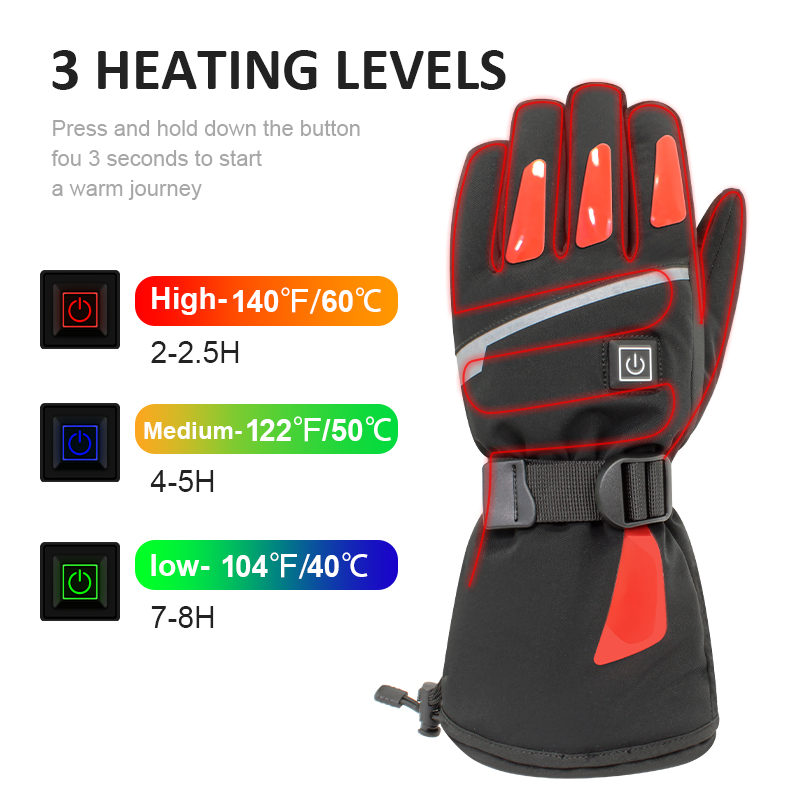
| High | 130–150°F (54–65°C) | 2.5–3.5 hours |
| Medium | 110–125°F (43–52°C) | 4–5 hours |
| Low | 95–105°F (35–41°C) | 6–8 hours |
How Ambient Temperature Affects Runtime
Cold temperatures reduce lithium-ion battery efficiency. The chemical reactions that produce electricity slow down in cold conditions, meaning the same battery delivers less runtime at 0°F than at 40°F.
| Ambient Temperature | Runtime Reduction |
| 40°F (4°C) | Baseline (100%) |
| 20°F (-7°C) | 80–85% of rated runtime |
| 0°F (-18°C) | 60–70% of rated runtime |
| -20°F (-29°C) | 40–50% of rated runtime |
This means a battery rated for 6 hours on low at 40°F may only deliver 3.5–4 hours at 0°F. For extreme cold use, always carry spare batteries.
Tips to Maximize Heated Gloves Battery Life
1. Start High, Then Drop Down
The most efficient strategy is to start on the highest heat setting for 10–15 minutes to establish warmth, then switch to medium or low to maintain it. Your gloves need more energy to warm up cold hands than to maintain already-warm hands.
2. Pre-Warm Your Hands
Cold hands drain batteries faster because the heating elements work harder to overcome the temperature differential. Warm your hands before putting on the gloves — use hand warmers, warm water, or simply tuck them in your armpits for a minute.
3. Keep Batteries Warm Before Use
Store batteries in an inside jacket pocket close to your body before use. A battery at body temperature (98°F) delivers 20–30% more runtime than one stored in an outer pocket at ambient temperature.
4. Use Lower Settings When Active
If you’re skiing, hiking, or otherwise generating body heat through movement, you don’t need the highest setting. Drop to low or medium — your body heat supplements the heating elements.
5. Carry Spare Batteries
Most quality heated gloves accept interchangeable battery packs. Carrying one or two spares effectively doubles or triples your total runtime. Spare batteries are small (3–5 ounces each) and easily fit in a jacket pocket.
6. Turn Off When Not Needed
During breaks, warm car rides, or indoor stops, turn off the gloves. Even on low settings, batteries drain continuously when on.
Battery Charging Best Practices
How you charge your heated gloves batteries significantly impacts their long-term lifespan. Lithium-ion batteries degrade over time, but proper charging habits can extend useful life from 1–2 years to 3+ years.
Do:
- Charge at room temperature (60–75°F / 15–24°C) — charging in extreme cold or heat degrades battery chemistry
- Use the manufacturer-provided charger — third-party chargers may deliver incorrect voltage or current
- Charge to 100% before first use — ensures the battery management system calibrates properly
- Store at 50% charge during off-season — fully charged or fully depleted storage causes stress
- Charge every 2–3 months during storage — prevents deep discharge which can permanently damage batteries
Don’t:
- Don’t leave batteries charging overnight unattended — while quality chargers stop at 100%, prolonged charging generates heat
- Don’t charge in freezing temperatures — can cause lithium plating that permanently reduces capacity
- Don’t use damaged batteries — bulging, leaking, or hot batteries should be disposed of properly
- Don’t mix old and new batteries in the same gloves — uneven discharge can cause overheating
Battery Safety Features in Quality Heated Gloves
When combining batteries, electrical current, and wearable fabric, safety is paramount. Quality heated gloves incorporate multiple protection circuits:
Overheat Protection
Temperature sensors monitor the heating elements. If temperature exceeds safe limits (typically 150°F / 65°C), the circuit automatically shuts off power to prevent burns.
Short-Circuit Protection
If the wiring is damaged or exposed, the battery management system detects the abnormal current flow and cuts power immediately — preventing fire or injury.
Over-Discharge Protection
Lithium-ion batteries are damaged if discharged below 2.5V per cell. Quality battery packs include protection circuits that shut off power before this threshold, preserving battery health.
Waterproof Battery Housings
Heated gloves batteries are enclosed in sealed housings rated IPX4 to IP67, protecting against rain, snow, and moisture infiltration. NRheat’s battery packs carry IP67 ratings — meaning they can withstand immersion in up to 1 meter of water for 30 minutes.
Signs Your Battery Needs Replacement
Even with proper care, heated gloves batteries eventually degrade. Watch for these signs:
- Significantly reduced runtime — if your battery lasts less than 60% of its original runtime, it’s nearing end of life
- Slow charging — takes much longer to reach full charge than when new
- Overheating during charging or use — indicates internal cell degradation
- Physical damage — bulging, cracking, or leaking requires immediate replacement
- Inconsistent heat output — fluctuating temperatures on the same setting suggest battery management system issues
Most quality manufacturers offer replacement batteries. NRheat provides interchangeable battery packs compatible across their heated glove product lines, available in 2,200mAh, 3,000mAh, and custom capacities up to 5,000mAh with USB-C and magnetic quick-release connector options.
Frequently Asked Questions
How long do heated gloves batteries last per charge?
With a standard 3,000mAh battery, expect 2–3 hours on high, 4–5 hours on medium, and 6–8 hours on low at 20°F (-7°C). Cold temperatures reduce runtime by 15–40%.
How many years do heated glove batteries last?
With proper care, lithium-ion heated glove batteries last 2–3 years or approximately 500 charge cycles before significant capacity loss.
Can I use a higher capacity battery in my heated gloves?
Only if the manufacturer specifies compatibility. Using a higher-capacity battery not rated for your gloves can cause overheating or damage to the heating elements.
Are heated glove batteries allowed on airplanes?
Yes. Lithium-ion batteries under 100Wh (watt-hours) are permitted in carry-on luggage. A 7.4V 5,000mAh battery equals 37Wh — well under the limit. Always carry batteries in carry-on, never in checked baggage.
Can I charge my heated gloves batteries with a phone charger?
Only if the voltage and connector match. Most heated gloves use proprietary chargers or USB-C at specific voltages. Using an incompatible charger can damage batteries or create safety hazards.
Conclusion
Understanding heated gloves battery life helps you set realistic expectations and get the most from your investment. The key takeaways: choose 7.4V systems with at least 3,000mAh capacity, manage your heat settings strategically, keep batteries warm before use, and always carry spares for all-day cold-weather activities.
Quality battery technology makes the difference between gloves that perform reliably season after season and gloves that leave you with cold hands after an hour. Manufacturers like NRheat engineer their battery systems for extreme cold performance, with IP67-rated housings, multi-level safety protection, and capacities up to 5,000mAh. Their 16+ years of heated apparel manufacturing experience means every battery system is tested for cold-weather runtime, charge cycle longevity, and safety compliance before it reaches customers.
Choose the right batteries, care for them properly, and your heated gloves will deliver consistent warmth whenever you need it — from the first cold morning to the last run of the season.


