

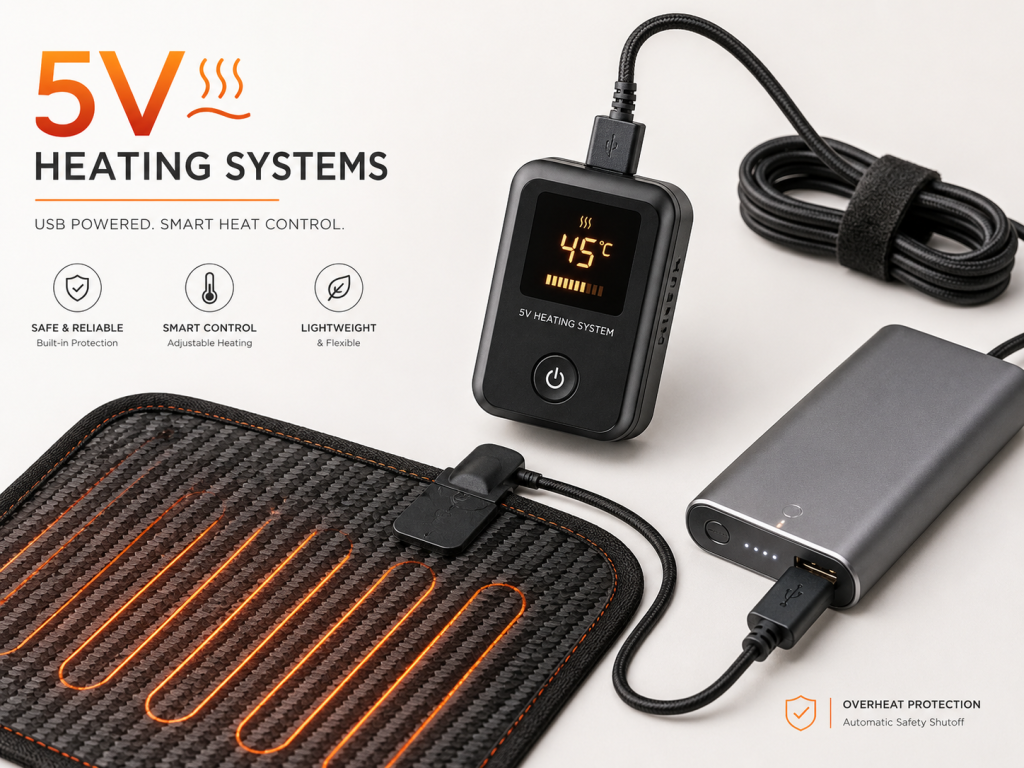
Why 5V Heating Systems Fail in Mining Environments
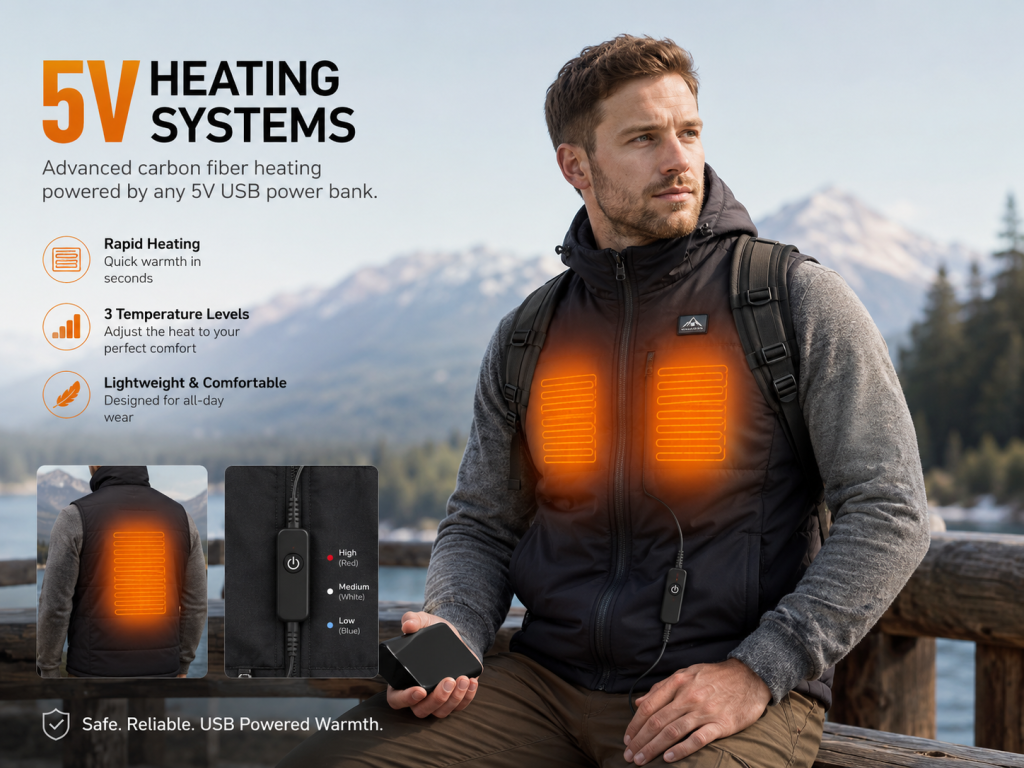
Many companies entering the heated workwear market start with 5V or 5V/2A heating systems borrowed from consumer products. These systems are designed for casual outdoor use, short durations, and moderate cold. In mining environments, they fail for three critical reasons.
First, power output is insufficient. A 5V/2A system delivers approximately 10 watts of heating power. In sub-zero temperatures with wind exposure, the human body loses heat faster than 10 watts can replenish it. Workers report feeling warm for the first thirty minutes, then experiencing a gradual decline as the heating elements cannot keep pace with heat loss.
Second, heating zone coverage is inadequate. Consumer-grade 5V systems typically feature two to three small heating zones concentrated on the chest and back. Mining workwear needs comprehensive coverage including the neck, shoulders, lower back, and optionally the arms and hands, because miners perform physical labour that engages the entire upper body.
Third, battery life degrades rapidly in cold conditions. Lithium-ion batteries lose significant capacity at temperatures below zero degrees Celsius. A 5V system rated for six hours at room temperature may deliver only two to three hours in a freezing mine shaft, leaving workers unprotected for the majority of their shift.
12V vs 7.4V Heating Systems: A Technical Comparison
For industrial applications, the two viable options are 7.4V and 12V systems. The choice depends on the specific working conditions and the level of heat required.
7.4V Systems: Balanced Performance
7.4V systems deliver between 15 and 25 watts of heating power, depending on the configuration. They represent a significant upgrade over 5V systems and are suitable for moderately cold environments where workers are physically active. The advantage of 7.4V is that it uses smaller, lighter battery packs that are easier to integrate into garments without adding excessive weight.
However, for extreme cold environments such as high-altitude mining operations in Chile, Peru, or Mongolia, 7.4V systems may still struggle to maintain comfortable body temperature during periods of inactivity, such as equipment monitoring or waiting for blasting operations to complete.
12V Systems: Maximum Heat Output
12V systems deliver 25 to 35 watts or more of actual heating power, making them the gold standard for extreme cold industrial applications. The higher voltage allows for more heating zones, larger heating elements, and faster warm-up times. A 12V system can bring a garment from ambient temperature to comfortable warmth in under three minutes, compared to ten minutes or more for a 5V system.
The trade-off is battery size and weight. A 12V battery pack is larger and heavier, which must be factored into the garment design. However, for mining applications where workers are already wearing heavy protective gear, the additional weight of a 12V battery is negligible compared to the safety benefit of reliable, sustained warmth.
Key Technical Specifications for Mining Heated Workwear
When evaluating industrial heated workwear for mining, procurement teams should look for the following specifications:
- Heating power: 25-35W actual maximum output (12V system)
- Heating zones: Minimum 5-6 large zones covering chest, back, shoulders, and neck
- Heating elements: Carbon fibre, graphene, or PTC (positive temperature coefficient) elements for durability and even heat distribution
- Temperature control: Dual-zone independent control (front and back) with at least three heat settings
- Temperature sensor: Built-in sensor with overheat protection, limiting garment temperature to approximately 45 degrees Celsius
- Battery: Certified lithium-ion battery pack with capacity of at least 10,000mAh for 12V systems
- Wiring: Flexible, washable wiring harness that can withstand industrial laundering
- Safety certification: CE, FCC, and RoHS compliance at minimum; flame-resistant materials for mining environments
Material Requirements for Mining Environments
The outer shell of mining heated workwear must meet additional requirements beyond heating performance. High-visibility fabrics certified to ISO 20471 Class 3 are essential for safety compliance. The outer fabric should be Oxford 300D or equivalent with polyurethane coating for water and wind resistance. Reflective tape, such as 3M Scotchlite, should be integrated into the design for visibility in low-light conditions.
Inner insulation is equally important. The garment should feature improved thermal lining that works in conjunction with the heating system, not against it. A common mistake is using thin insulation that relies entirely on the heating system for warmth. In a power failure scenario, the garment should still provide baseline thermal protection.
The Sampling and Validation Process
Before committing to a production order of hundreds or thousands of units, mining companies should request a small batch of samples, typically five units, for field testing. The validation process should include:
- Wear testing across different job roles and activity levels
- Battery life testing in actual working conditions, not just laboratory simulations
- Wash testing to verify the durability of the heating system after industrial laundering
- Compatibility testing with existing PPE (personal protective equipment) including helmets, harnesses, and respiratory equipment
This sampling phase is critical. One mining company in Chile invested in 1,000 units of heated workwear from a supplier using a 5V/2A system, only to discover that the heating performance was inadequate for their sub-zero, high-altitude working conditions. The entire batch could not be commercialised, resulting in significant financial loss. A thorough sampling and validation process would have identified this issue before the production order was placed.
How to Evaluate a Heated Workwear Supplier
When selecting a manufacturer for industrial heated workwear, look beyond price quotes. Ask potential suppliers about their in-house heating system design capabilities, their experience with industrial applications, and their testing infrastructure. A manufacturer that designs its own heating systems, rather than buying off-the-shelf components, will be able to customise power output, zone placement, and temperature control to match your specific working conditions.
Request evidence of certifications and ask about their quality control processes. Does the manufacturer have in-house testing labs? Do they perform aging tests on heating elements? What is their warranty policy for industrial clients? These questions will help you distinguish between consumer-grade suppliers repackaging their products as industrial, and genuine industrial heated workwear manufacturers.
Looking for a heated workwear partner with proven industrial expertise? NRheat designs custom 12V heating systems for mining and industrial applications, with 16 years of manufacturing experience and CE/FCC/RoHS certified production. Request a sample batch today.


